William Falconer CNZM retires from role as Chair of the MWC Board
Founding MWC chair, William (Bill) Falconer has seen through four MWC iterations, four directors and now, 23 years later at the age of 86, he is stepping down.
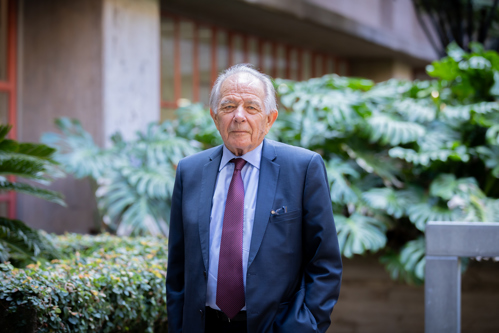
In 2002, a brief conversation with former colleague John Hood, (then, Vice Chancellor of the University of Auckland) introduced Bill to the Centre of Excellence for Molecular Biodiscovery. Early the following year it was renamed the Maurice Wilkins Centre for Molecular Biodiscovery and Bill was appointed as the founding Board Chair.
MWC has been an important part of a busy life. Bill had already completed a long career as a trade negotiator in London, Rome, Washington DC and Geneva, and then another lifetime of work initially in the petroleum industry, and then as an independent director, sitting on 25 high profile boards, chairing 18 of them. But he baulks at governance.
“I never use the word. A board’s function is to ensure that management correctly defines the objectives it is pursuing and then plans for their achievement. The board’s task is to ensure that management is accountable to these commitments and plans and reports accordingly. If this is governance so be it, but they are concrete terms.”
In the early 2000s, the aim of Centres of Research Excellence (CoREs) was to foster more collaboration across crucial fields of science. In Bill’s first years as Chair, the Centre built a workable model of cross-laboratory and institutional collaboration. His role has been to ensure the board works to secure accountability and compliance with all the rules, relationships and laws which affect the research, including those related to research and the individual research organisations within the CoRE’s collaborative structure.
Bill says, “If I contributed anything, it was to put that structure over this new collaborative body and hold the researchers accountable for making it work.”
Prof Rod Dunbar, MWC Principal Investigator, first met Bill in 2004, becoming closer during his role as MWC Director from 2009–2019. He credits Bill’s consistent sage counsel and decision-making processes for MWC’s tremendous stability.
Prof Dave Grattan, the current MWC Director agrees “Bill is an absolute rock. His approach has been advice rather than direction, always asking ‘What can we do to help you deliver?’.”
It is the “huge undertaking” of initially the Māori Engagement Strategy and more recently the Pacific Strategy that Bill looks back at with the most pride. The Māori Engagement Strategy aims to challenge and redress health inequality through biomedical science, requiring deepening scientists’ understanding of Māori approaches toward illness, and simultaneously growing the pool of Māori scientists, beginning with exposing secondary students to biomedical research. The Pacific Strategy combines aspects of the Māori Engagement Strategy with unique goals in response to the needs of Pacific researchers and communities.
Bill admits he probably took the most convincing as to whether the Engagement Strategy could be added to an already heavy research workload, not least in recruiting Māori into the research, and gaining whānau respect for the initiative. But he has been impressed with the speed and quality of progress. “I will miss seeing that science unfold”.
“In a sense, the processes of MWC and the people are in my DNA. My professors, they are geniuses, and it is always an honour to be with a genius and when researchers from each theme – Cancer, Metabolic Health, Infectious Diseases - reported to the board, I could sit all day with these impressively smart people and hear about their innovative science. I was honoured to be a part of that.”